Species at a glance
- Common names
- Sockeye Salmon; Red Salmon during spawning; sometimes Blueback Salmon at sea. Kokanee is the freshwater-resident form of the same species.
- Appearance
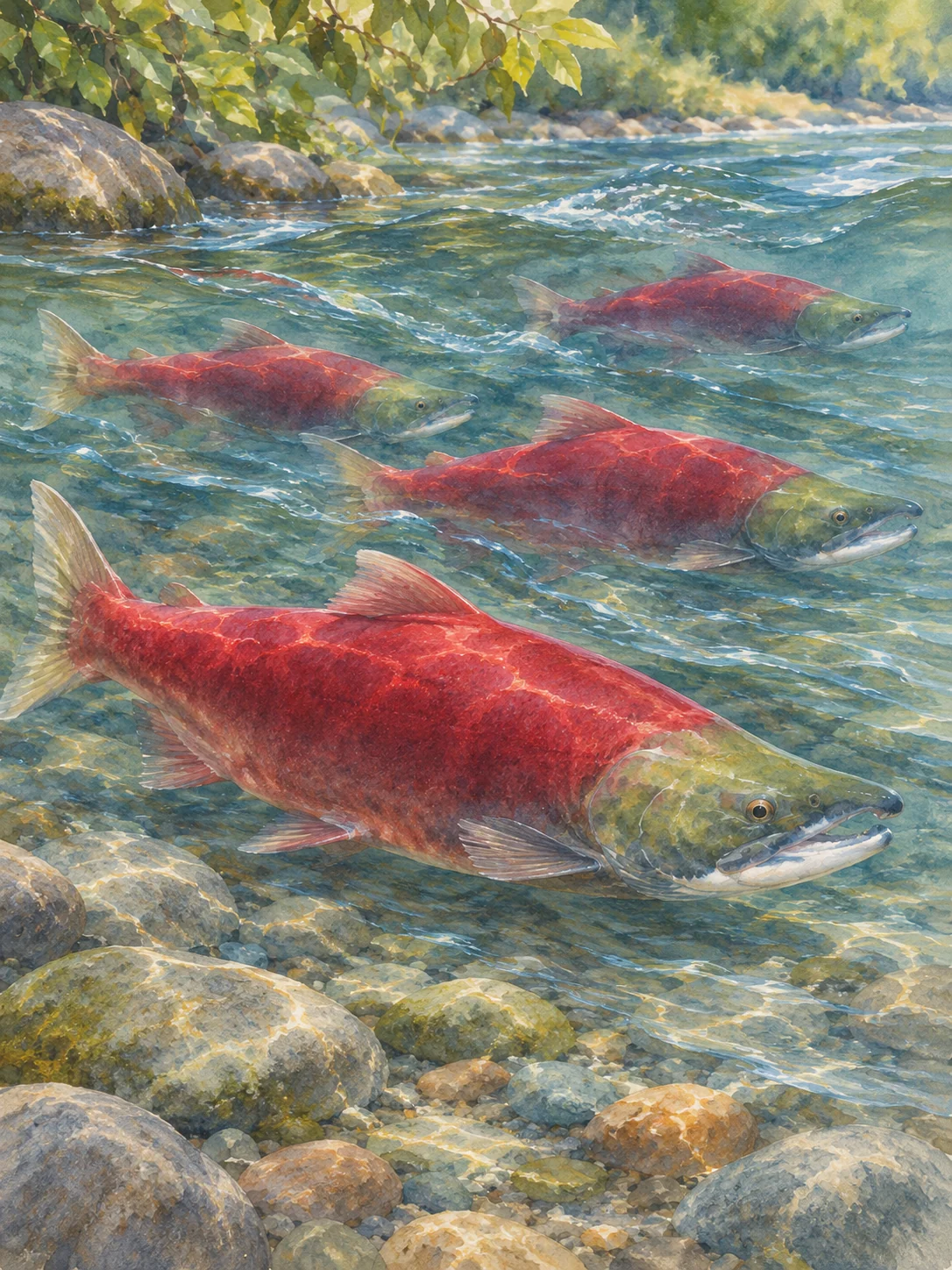
- At sea, dark blue-green above with silver sides. During spawning, adults typically develop a red body and olive-green head; males often show a hooked jaw and raised back.
- Identification
- No prominent black spots on the back or tail, unlike several other Pacific salmon; long, fine gill rakers used to retain small prey.
- Typical adult size
- Often about 45–80 cm long; size varies considerably among populations. Freshwater-resident kokanee are generally smaller.
- BC range
- Fraser, Skeena, Nass and other coastal and interior systems, including Okanagan waters connected to the Columbia River.
- Life cycle
- Most juveniles grow in freshwater nursery lakes before migrating to sea. Adults return to spawn once and die afterward.
- Season
- Many BC populations spawn in late summer or autumn, but timing varies by watershed and run.
How to recognize it
An ocean-phase Sockeye is sleek and silver, with a metallic blue-green back and no large, distinct black spots on its tail. Near spawning, the contrast becomes unmistakable: a scarlet-to-brick-red body meets an olive or jade-green head. Breeding males may develop a pronounced hump, a hooked snout called a kype, and larger teeth; females change colour too, generally without such exaggerated features. [1, 3]
Lookalikes are easiest to separate by checking more than colour. Coho Salmon often show spots on the upper portion of their tails, while Chinook Salmon have dark spotting on both tail lobes. Chum Salmon develop mottled purple and olive bars rather than the classic red-and-green Sockeye pattern. Kokanee look similar during spawning but spend their lives in freshwater lakes and tend to be smaller. [1, 2]
Where Sockeye live
Sockeye connect coastal and interior British Columbia. Important spawning and nursery systems include the Fraser watershed’s Shuswap, Chilko, Quesnel and other lake basins, as well as northern river systems such as the Skeena and Nass. Okanagan Sockeye follow a different route: from the Pacific through the Columbia River system to spawning waters in southern BC. [2, 3, 8]
Many populations depend on lakes for their earliest years. Spawning takes place in well-oxygenated gravel in tributaries, lake outlets and, in some systems, lake shores with groundwater flow. This diversity matters: not every Sockeye follows exactly the same freshwater route or spends the same length of time in a lake. [1, 3]
The journey from lake to ocean and home again
A female Sockeye beats her tail to dig a nest, called a redd, into gravel. After eggs are deposited and fertilized, the developing young remain sheltered beneath the stones. Newly hatched alevins rely on their attached yolk sacs. Most fry then move into a connected freshwater lake, where they feed and grow, commonly for about one or two years before travelling downstream toward the sea. Some river-type populations migrate to the ocean sooner. [1, 3]
In the North Pacific, Sockeye generally feed on planktonic crustaceans such as copepods and krill, although larger fish can also take other prey, including small fish. Fine, closely spaced gill rakers help them retain small food organisms. Carotenoid pigments acquired through their diet contribute to the rich red colouring associated with Sockeye. [1, 2]
As adults mature, they travel toward their home watershed. Ocean navigation and remembered chemical cues both contribute to the return. During the final freshwater migration, adults generally stop feeding, relying on stored energy while their bodies change colour. Once they have spawned, they die, completing a life cycle that links distant marine waters with a particular inland spawning place. [3]
Why Sockeye matter
Sockeye are both consumers and providers of food. In lakes and the ocean, they participate in plankton-rich food webs. On their return, bears and other wildlife can feed on migrating or dying adults. After spawning, salmon remains contribute marine-derived nutrients to streams, aquatic food webs and streamside vegetation. Studies of Pacific salmon streams have documented the movement of salmon-derived nitrogen into nearby trees. [3, 7]
These connections run through the whole Salmon Streams collection. Black Bears, Bald Eagles and River Otters can benefit from salmon runs where their ranges overlap. Aquatic insects, including caddisflies, belong to the freshwater food webs shaped by stream conditions and nutrient cycling. Streamside trees, including Red Alder, help shade water and stabilize banks. Each relationship varies with place and season, but together they show why healthy salmon habitat is more than a stretch of river. [3, 7, 10]
First Nations relationships and stewardship
Sockeye are part of the food systems, living cultures, responsibilities and stewardship practices of many First Nations across British Columbia. Specific relationships and protocols differ by Nation and watershed and should not be reduced to a single provincial story.
In the Okanagan, the Syilx Okanagan Nation has led long-term Sockeye recovery efforts, including habitat and fish-passage improvements, fish-health monitoring and a conservation hatchery. Its 2026 reporting describes egg collection and rearing work intended to support future returns. This is one documented example of Indigenous-led stewardship, not a substitute for the distinct histories and knowledge of other Nations. [8, 9]
Along the Adams River, Tsútswecw Park’s name reflects Secwépemc connections to the land and waters. BC Parks identifies the river as a major Sockeye spawning area and explains the four-year rhythm of particularly large runs. [5]
Conservation: many runs, many different futures
Sockeye cannot be described accurately by one province-wide risk label. The BC Conservation Data Centre records the species-level provincial rank as SNR (not ranked) and the BC List as Not Reviewed. Separately, COSEWIC assesses individual populations or designatable units. Its 2017 report assessed 24 extant Fraser River units: eight Endangered, two Threatened, five Special Concern and nine Not at Risk. Its 2021 report also examined seven original Fraser River populations, identifying three as Extinct, two as Endangered and two as Special Concern. These are scientific assessments, not automatically federal legal listings. [1, 3, 4]
Fisheries and Oceans Canada manages wild salmon through population-based Conservation Units and fisheries and habitat measures. The federal government consulted on potential listings for 12 Fraser River Sockeye designatable units under the Species at Risk Act from September 9 to November 9, 2026. [10, 11]
Climate change, warming rivers, low flows, barriers to migration, habitat degradation, altered marine conditions and fishing pressure can affect runs in different ways. The challenge is protecting the diversity of spawning populations and their connected freshwater and marine habitats rather than assuming that the success of one large run means all others are secure. [3, 4, 10]
Five details worth noticing
- A Sockeye at sea may look almost like a different species from the same fish returning to spawn: silver and blue-green become brilliant red and green.
- The tall, fine gill rakers that help Sockeye gather small prey are a useful anatomical clue, even when the fish is not in spawning colour.
- Some Sockeye spawn in gravel along lake shores, not only in river channels. The flow of oxygen-rich water through the gravel matters.
- The famous Adams River has a strong four-year cycle. BC Parks identifies 2026 and 2030 as dominant run years, although numbers vary. [5]
- Sockeye do not all follow one life history. Most juveniles use nursery lakes, while river-type populations can move seaward sooner.
A respectful way to watch a salmon run
Watch from established trails, bridges or viewing platforms and remain quiet. Do not walk into spawning streams or across gravel that may hold buried eggs. Keep dogs on a leash and out of the water, follow local Indigenous and park guidance, and be alert to swift, cold water and wildlife. Polarized sunglasses help reduce glare without disturbing the fish. [5, 12]
Explore the Salmon Streams collection
Coho Salmon (Oncorhynchus kisutch): Compare the spawning colours and the placement of dark spots on the tail.
Chinook Salmon (Oncorhynchus tshawytscha): Notice how the body size and tail spotting differ from Sockeye.
Steelhead Trout (Oncorhynchus mykiss): Discover a related migratory fish that, unlike Sockeye, can survive spawning and reproduce again.
Black Bear (Ursus americanus), Bald Eagle (Haliaeetus leucocephalus) and River Otter (Lontra canadensis): Explore the animals that can use salmon as an important seasonal food source.
Red Alder (Alnus rubra) and Caddisflies (order Trichoptera): See how streamside habitat and aquatic food webs are connected to healthy salmon waters.