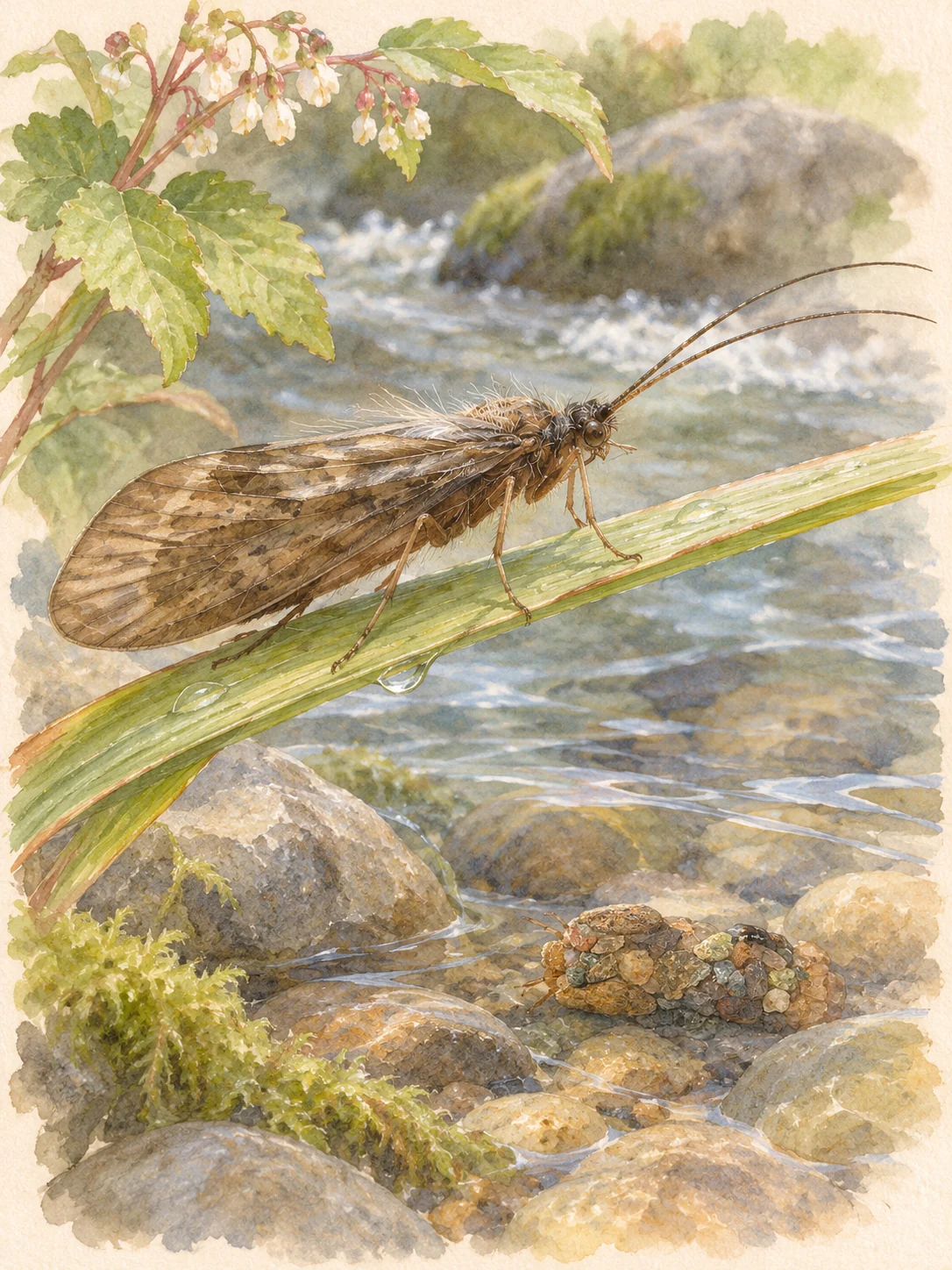
Species at a glance
- Common name
- Caddisflies; some adults are also called sedges.
- Adult appearance
- Usually small, moth-like insects with long threadlike antennae and two pairs of finely hairy wings, often folded in a roof-like shape.
- Larval appearance
- Aquatic insects with a hardened head, three pairs of jointed legs and a softer abdomen; some carry cases of gravel or plant material.
- Life cycle
- Egg, aquatic larva, aquatic pupa and winged adult.
- Activity
- Larvae develop underwater; adult emergence varies by species and location, from spring into autumn.
How to recognize them
An adult caddisfly can look like a modest brown or grey moth. Look for its unusually long, slender antennae and fine hairs on the wings. At rest, many hold their wings over the body like a pitched roof. Moths have scaly rather than hairy wings, although close examination may be needed to distinguish them confidently. [1, 2]
Underwater, caddisfly larvae have a dark, hardened head and three pairs of thoracic legs. Many live in portable cases of sand, tiny stones, bark or plant fragments. Others attach silken retreats and capture nets to rocks, while some are free-living predators with no portable case. A tiny gravel tube is a useful clue, but not all caddisfly larvae live inside one. [1, 2]
Where they live in British Columbia
Caddisflies occur in many of BC’s freshwater landscapes, from shaded coastal streams on Vancouver Island to rivers, wetlands and cold mountain waters farther inland. Species differ in their preferred flow, temperature, food and streambed materials. Some are common in swift, oxygen-rich riffles; others live in quiet water among submerged vegetation or leaf litter. [1, 3, 8]
In coastal salmon streams, larvae may be found on and between cobbles, beneath woody debris or among wet leaves. Their cases can blend so closely with the streambed that a living animal looks like a moving bit of gravel. These are examples of habitats, not proof that any one caddisfly species occurs in every BC stream. [1, 2]
A life that moves between water and air
Caddisflies undergo complete metamorphosis. Eggs are laid in or near water. The developing larvae spend their aquatic lives feeding, growing and, in many species, constructing or enlarging protective shelters. They then pupate underwater before emerging as winged adults. [1, 2]
Adults live on land around freshwater and may rest on streamside plants, rocks or trees. Many are most active around dusk or after dark. Emergence times vary considerably across BC species: some fly in spring or summer, while others appear later in the year. Their adult stage links the stream to birds, bats and other insect-eating wildlife. [2, 3]
Why caddisflies matter: the stream’s small engineers
Caddisfly larvae perform different jobs in freshwater food webs. Some shred fallen leaves, including suitable riparian leaf litter; others graze algae from stones, gather organic particles or use silk nets to catch food carried by the current. Still others hunt small aquatic invertebrates. These contrasting feeding strategies help move energy and nutrients through stream habitats. [1, 2, 9]
The silk itself is remarkable. Case-building larvae fasten together sand, pebbles, bark or plant fragments to make protective homes. Net-spinning species weave stationary traps in flowing water, while free-living forms do not carry a case. The pebble case shown in the artwork represents just one way a caddisfly can live. [1, 2]
Caddisfly larvae and emerging adults are also prey. Research from Alaskan streams documents caddisfly larvae among the aquatic insects eaten by juvenile Coho Salmon, and BC natural-history accounts identify caddisflies among the aquatic prey of American Dippers. These connections show how stream insects can nourish fish and birds, without implying that every caddisfly species is equally important in every watershed. [6, 7]
What caddisflies can tell us about stream health
Biologists sample bottom-dwelling invertebrates to help assess freshwater conditions. Caddisflies are often considered alongside mayflies and stoneflies in a group known as EPT. BC stream monitoring reports use measures such as the percentage of caddisflies and the number of caddisfly families found in a sample. [1, 5]
Many caddisfly groups are sensitive to excess fine sediment, low oxygen or other disturbances. Others are more tolerant. Finding a caddisfly therefore does not, on its own, prove that a stream is clean. The mix of organisms and the site’s conditions matter more than the presence of one insect. [1, 5]
Conservation and caring for salmon streams
Because Trichoptera is an order containing many species, it cannot accurately be given one endangered, secure or not-at-risk designation. Conservation assessments, where available, apply to individual taxa. The number of known BC species is also not fixed: researchers published new provincial records in 2026. [3, 4, 8]
Caddisflies depend on functioning freshwater habitat. Excess sediment, degraded banks, changes to stream flow, polluted runoff and loss of streamside vegetation can alter the conditions larvae need. Protecting native riparian plants, limiting erosion and keeping streams connected benefit aquatic invertebrates and the wider salmon-stream community. First Nations and local stewardship organizations provide place-specific guidance for caring for these waterways. [1, 5]
Five details worth noticing
- The word Trichoptera means “hair-winged”, a reference to the fine hairs covering adult wings. [3]
- Some larvae carry homes built from tiny pebbles, leaves or twigs, glued together with their own silk. [1, 2]
- Not all caddisflies make portable cases: some spin underwater nets and others live freely among rocks. [1, 2]
- Their lives bridge habitats: immature stages develop in water, while winged adults return to the air. [2]
- New BC caddisfly records were published in 2026, a reminder that even familiar streams still hold discoveries. [4]
A respectful way to observe them
Watch a shaded streambank near dusk for delicate, moth-like adults resting on leaves or stones. In clear, shallow water you may notice an apparently moving pebble case. Observe it without disturbing the animal or its shelter. Keep feet out of sensitive streambeds and salmon spawning gravel, stay on established paths and follow local First Nations and conservation guidance.