Species at a glance
- Common names
- Chum Salmon; Dog Salmon; sometimes Calico Salmon, especially for spawning adults.
- Appearance
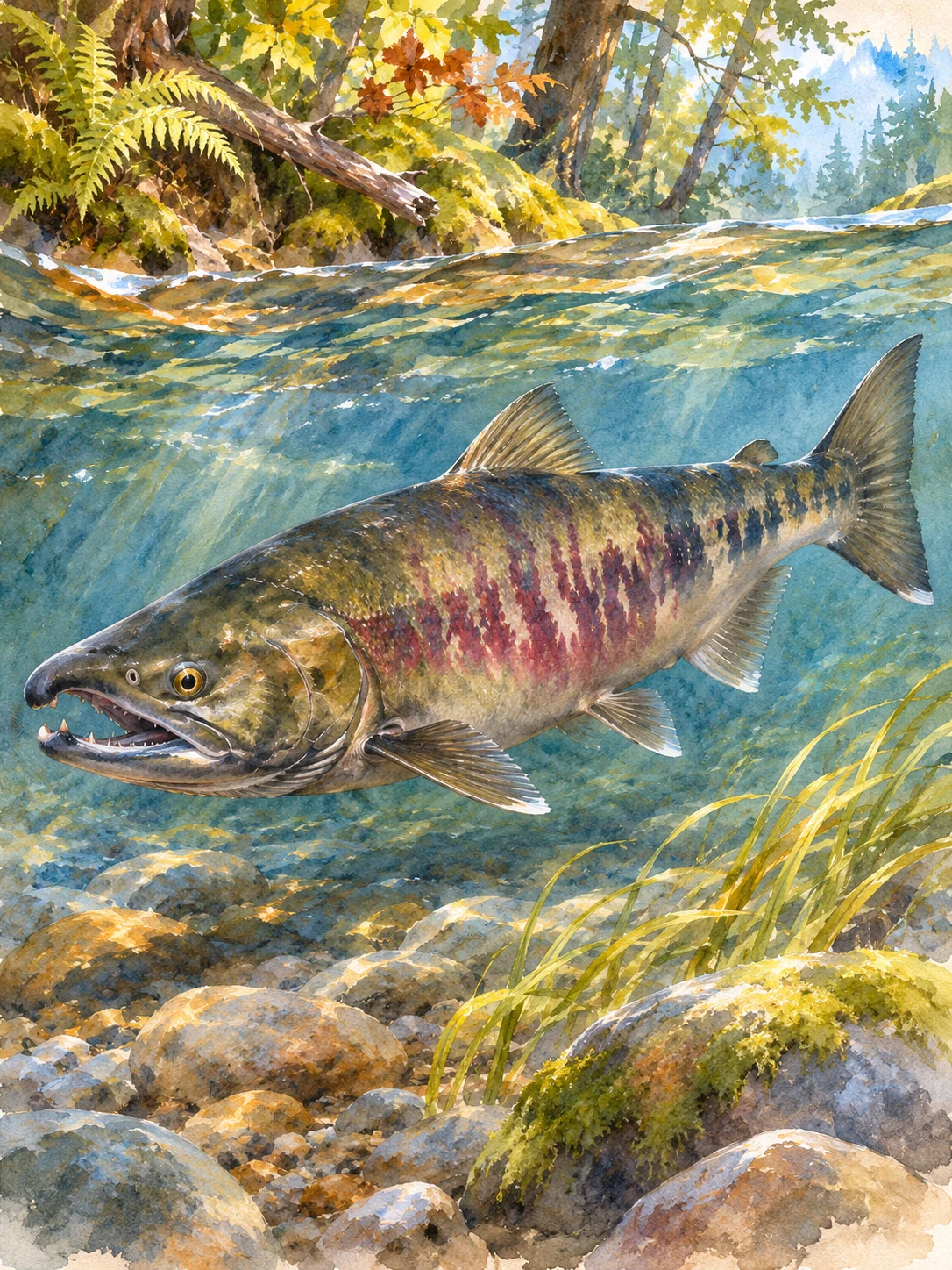
- At sea, metallic blue-green above with silver sides and a pale belly. Breeding males develop dark olive heads, a hooked upper jaw, enlarged teeth and jagged reddish-purple to charcoal vertical markings.
- Identification
- No distinct large black spots on the back or tail; a comparatively slender tail wrist; and white tips on the pelvic and anal fins in spawning adults. The strong calico pattern is especially characteristic of breeding males.
- BC range
- Coastal rivers and streams of Vancouver Island, the Fraser watershed, the mainland coast, Haida Gwaii and northern BC, with run timing and stock condition varying among watersheds.
- Life cycle
- Adults usually return after several years at sea, often at ages three to five. Fry generally travel downstream soon after emerging, making estuaries important nursery habitats.
- Season
- Many BC runs spawn in autumn or early winter. Some populations return earlier in summer, and timing differs by region.
How to recognize it
In the ocean, Chum Salmon have broad, streamlined silver bodies, blue-green backs and forked tails. Their backs may show fine speckling, but they lack the large, obvious black spots on the tail that help identify Chinook, Coho and Pink Salmon. The tail wrist, or caudal peduncle, is relatively narrow. No single field mark should be used without the others. [1, 2]
As spawning approaches, males change dramatically. The upper snout hooks into a kype, the lower jaw becomes more pronounced, and enlarged canine-like teeth appear. Irregular bars of rose, magenta, violet, green and near-black form the distinctive calico pattern. Females tend to have softer markings and less exaggerated jaws. White edges on pelvic and anal fins are an additional identification clue. [1, 2]
Sockeye Salmon can also turn brilliant red, but they do not develop the same broad, irregular calico bars. Male Chinook and Coho may form hooked jaws too, so the combination of spotting, fin edges, colour pattern and proportions is more reliable than the kype alone. [1, 2]
Where it lives
Chum Salmon spend much of their lives in the North Pacific, then return to freshwater rivers and streams. In BC, many populations spawn in lower river reaches, tributaries and side channels, often relatively close to tidewater. Females choose gravel in flowing, oxygenated water. Groundwater upwelling and tidal influence can be features of some spawning reaches. [1, 3, 10]
The journey from nest to ocean can be short. In some small coastal streams, fry can reach salt water within a day or two after leaving the gravel. Larger rivers can involve longer downstream travel. Young Chum use shallow estuaries, tidal sloughs and sheltered river margins where small invertebrates provide food and the changing water conditions allow a gradual transition to the sea. [1, 10]
A healthy Chum Salmon habitat therefore extends beyond the spawning site. Clean gravel, water flow, accessible stream channels, riparian shade and estuarine nursery areas all contribute to the fish's life cycle. Their relative importance varies among watersheds and seasons. [3, 10]
From gravel to the North Pacific
During a spawning run, a female uses her tail to excavate a gravel nest called a redd. After she deposits eggs and they are fertilized, the eggs are covered by gravel, where water must continue to carry oxygen to the developing young. The adults die after spawning. The embryos hatch in the colder months and remain sheltered beneath the stones while absorbing nutrients from their yolk sacs. [1, 2]
In spring, young fish emerge as fry and head downstream. Unlike juvenile Coho Salmon, which usually grow in streams for at least a year, young Chum Salmon generally spend little time in freshwater rearing habitat. Estuaries offer food, shelter and a transition to ocean salinity. Some larger river systems produce more prolonged freshwater migrations, so the short migration should not be treated as universal. [1, 10]
At sea, Chum Salmon feed on small marine animals and grow over several years. When mature, they return toward their natal streams. Their silvery colours darken as breeding season approaches, and the males' patterned sides and hooked jaws become unmistakable. After reproduction, their bodies can become food and nutrients for freshwater and streamside ecosystems. [1, 2, 8]
Why Chum Salmon matter
Chum Salmon connect ocean, estuary, stream and forest. Young salmon participate in coastal aquatic food webs. Adults bring ocean-grown biomass back into the watershed, where eggs, carcasses and living fish can feed other organisms and where nutrients may move through water, soil and vegetation. These relationships depend on the species and habitats present at each location. [3, 8]
On Haida Gwaii, University of Victoria researcher Thomas Reimchen documented one remarkable pathway. Black Bears carried spawning Chum Salmon from a stream into nearby forest. Crows, flies and other scavengers consumed remaining tissues, while nutrients entered the surrounding ecosystem. This carefully studied watershed illustrates a real salmon-to-forest relationship; it does not imply that identical processes occur at every salmon stream. [8]
Chum Salmon are therefore more than a fish passing through a river. Their seasonal return can influence the wider coastal landscape, a central theme of the Salmon Streams collection.
First Nations relationships and stewardship
Chum Salmon have long been important in Indigenous food systems and relationships with rivers and coastlines across British Columbia. First Nations continue to participate in salmon conservation, fisheries management, monitoring and the protection and restoration of habitats. Practices, knowledge, language names and responsibilities are specific to Nations and communities and should not be merged into a single story. [1, 3]
This page offers a broad ecological overview, not an account of any one Nation's teachings. Place-specific cultural or stewardship details should be developed from that Nation's own published information or with its guidance.
Conservation: widespread, but not uniformly secure
Chum Salmon occur across a vast North Pacific range, but population conditions vary. The BC Conservation Data Centre lists the species' global status as G5 (Secure), last dated May 2016, and its provincial status as SNR (not ranked), dated August 2019. The BC list says Not Reviewed. A species being unranked in BC does not mean every one of its local runs is secure. The CDC page does not display a species-level COSEWIC status or a SARA schedule designation. [2]
A 2022 peer-reviewed analysis of run sizes in 25 Central Coast BC watersheds estimated a regional decline of approximately 90% since 1960. That is a serious regional finding, not a statement that all British Columbia Chum Salmon have declined by the same amount. [5]
COSEWIC's candidate information updated in November 2026 identifies Chum Salmon populations from Haida Gwaii, the Central Coast, the Skeena and Vancouver Island/mainland inlets for consideration. Its status-report work refers to multiple provisional designatable units, whose number and boundaries may change during review. Candidate status does not mean a COSEWIC risk assessment has been completed or that a population is listed under the Species at Risk Act. [6, 7]
Threats and management questions differ among watersheds and stocks. Important concerns may include changing marine conditions, excessive sediment in spawning gravel, altered freshwater flows, warming streams, loss of estuarine habitat and fishing pressure on particular stocks. Indigenous stewardship, habitat restoration, fisheries management and careful monitoring all have roles, but a single province-wide conservation conclusion would be misleading. [3, 5, 6]
Five details worth noticing
- The name Dog Salmon refers to breeding males' prominent canine-like teeth. Calico Salmon refers to the patchwork of spawning colours. [1, 2]
- A bright silver ocean fish can develop olive, purple, reddish and dark charcoal bars as it prepares to spawn. [1, 2]
- Chum Salmon lack large black spots on the tail, unlike several other Pacific salmon species. [2]
- Many Chum fry head seaward almost immediately, making estuaries especially important during their early lives. [1, 10]
- Research on Haida Gwaii traced Chum Salmon nutrients into the forest through Black Bears, scavengers and soil food webs. [8]
A respectful way to watch a salmon run
Choose an established viewpoint and observe quietly from the bank. Stay out of spawning streams and off gravel redds, because eggs may remain beneath the stones after the adults have gone. Keep dogs on leash and out of the water. Do not handle, chase or throw objects at fish. Be alert to cold currents, slippery banks and bears, and follow local notices, Indigenous guidance and land-manager directions. [9]