Species at a glance
- Common names
- Coho Salmon; Silver Salmon (especially in their bright ocean phase).
- Appearance
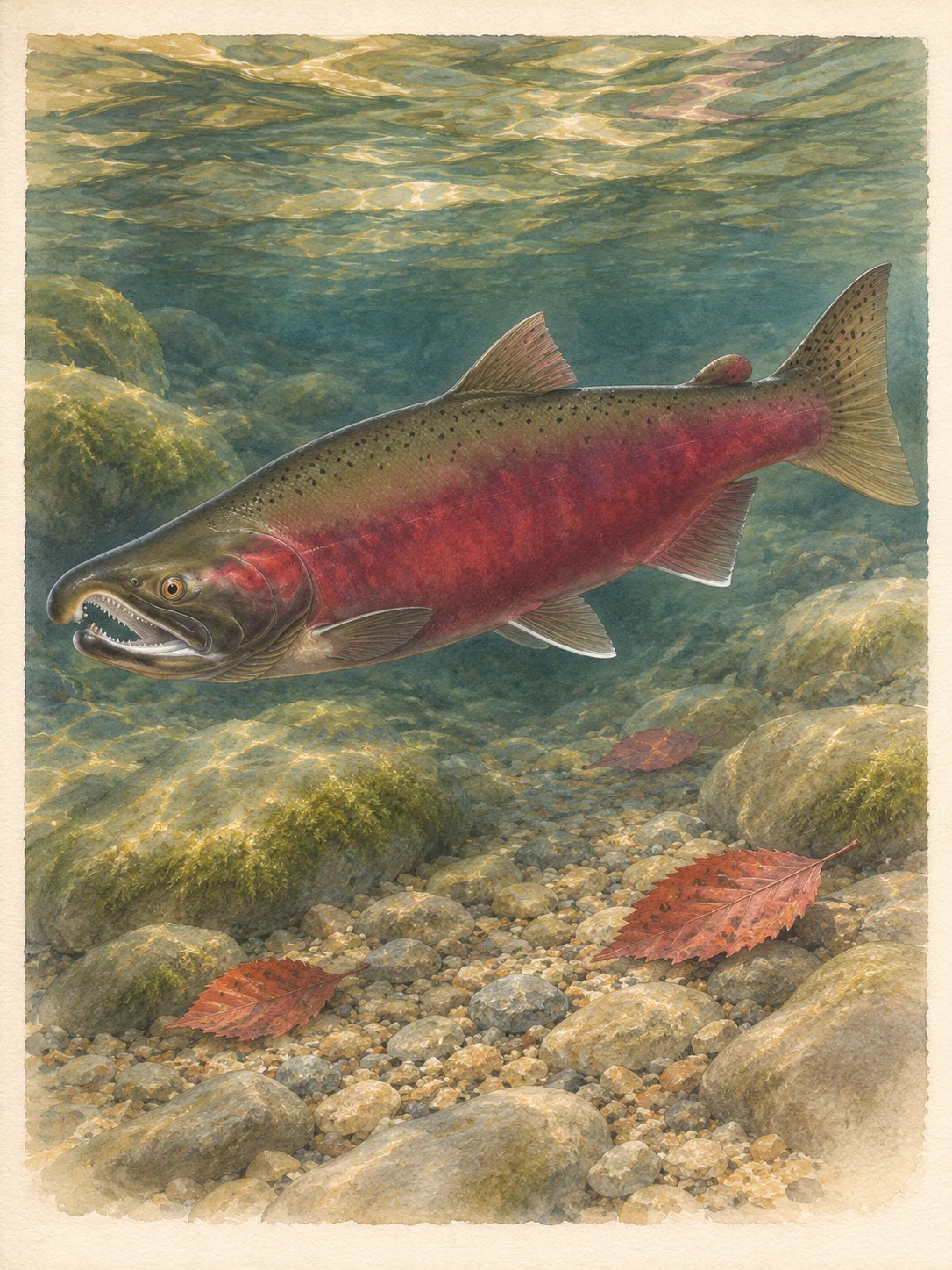
- Bright silver flanks and a dark metallic blue-green back at sea; olive-green back and reddish to maroon sides in spawning adults. Breeding males develop a strongly hooked upper jaw.
- Identification
- Small dark spots on the upper back and usually the upper lobe of the tail; pale gums at the base of the lower teeth; a stout tail base.
- BC range
- Coastal watersheds and rivers of Vancouver Island, the mainland coast, the Fraser system and northern BC, with population-specific migration routes.
- Life cycle
- Often three years from egg to spawning adult. Some fish spend an additional year in fresh water; a few males return early as smaller 'jacks'.
- Spawning season
- Mainly autumn into early winter in BC, with timing varying by watershed and year.
How to recognize it
In the ocean, a Coho Salmon is a streamlined silver fish with a dark blue-green back. Fine black spots appear across the back and, when present on the tail, are usually concentrated on its upper lobe. Its tail base is noticeably stout. The gums at the base of the lower teeth are pale or white, even though the tongue and the rest of the mouth can appear dark.
As spawning approaches, males may turn deep brick-red or maroon along the sides, with a darker olive-green head and back. Their upper jaw curves into a prominent hook called a kype, and their teeth become larger. Females also change colour, generally with a less exaggerated jaw. A useful comparison is Chinook Salmon, which usually have black lower gums and dark spots on both tail lobes.
Where it lives
Coho belong to an interconnected landscape of coastal and inland watersheds. Adults may return to surprisingly small tributaries, while juveniles use shaded pools, undercut banks, woody debris and slow side channels. These quieter places offer food and shelter, especially during powerful winter flows.
Young Coho also depend on off-channel wetlands and beaver ponds. Such habitats can provide calm water when the main stream becomes swift and turbulent. Research in Pacific Northwest streams has documented the importance of these sheltered areas, although habitat needs and survival rates differ among BC watersheds.
At sea, Coho feed in coastal waters, including waters connected to the Salish Sea and the continental shelf. Their use of freshwater, estuarine and marine habitat means that changes in any one part of the journey can affect a population's success.
A life between forest and sea
A female Coho uses her tail to excavate a nest in clean, oxygen-rich gravel. This nest, called a redd, holds eggs through the winter. Tiny young fish hatch with a yolk sac that nourishes them while they remain hidden among the stones. In spring, they emerge as fry and begin feeding in the stream.
Unlike salmon species that move quickly toward the sea, most young Coho spend at least one full year in fresh water; some remain for two. They feed on aquatic and terrestrial insects, shelter among roots and fallen wood, and seek slower water during winter floods. In spring, they become silvery smolts, physiologically prepared for life in salt water.
After a marine feeding period, adults return toward their natal rivers, guided in part by remembered chemical cues. Autumn rainfall often makes small streams passable again. Most complete a roughly three-year life cycle, although age and timing vary. After spawning, the adults die, leaving a new generation beneath the gravel.
Why Coho matter
Coho help connect a river's smallest pools with its surrounding forest and the open sea. Their fry eat aquatic insects, including caddisfly larvae that live among streambed stones and fallen leaves. Red alder and other streamside trees shade nursery water, and woody debris helps create sheltered places where young fish can survive.
Young Coho share coastal streams with species such as Steelhead Trout, often using slower pools while juvenile Steelhead occupy faster water. During spawning runs, Coho and their carcasses can become food for Black Bears, River Otters and Bald Eagles where their habitats overlap. Nutrients brought from the ocean may also enter streamside food webs and vegetation.
First Nations relationships and stewardship
Coho Salmon are part of living Indigenous food systems, knowledge and stewardship across British Columbia. Relationships with salmon, harvesting practices and responsibilities for particular rivers differ among Nations and communities. First Nations continue to contribute to fisheries management and the protection and restoration of salmon habitat.
This page presents a broad BC ecological overview, not an account of the teachings or practices of any one Nation. Place-specific cultural knowledge should be presented with the appropriate Nation's own sources and guidance.
Conservation: many populations, different challenges
A species can be widespread while individual salmon populations face serious risks. Coho are tracked through distinct management and conservation units, so a single province-wide label cannot describe the condition of every BC run.
The BC Conservation Data Centre currently records the species Oncorhynchus kisutch as SNR (not ranked) and Not Reviewed on the provincial list. Separately, COSEWIC assessed the Interior Fraser population as Threatened in November 2016, following an earlier Endangered assessment in 2002. Those assessments are population-specific and are not identical to legal listing under the Species at Risk Act. Federal consultation about potentially listing Interior Fraser Coho as Threatened ran from April to June 2026; the referenced federal page describes the listing decision as under consideration.
Pressures can include warmer water, summer drought, altered streamflows, degraded wetlands, barriers to migration, changing ocean conditions and pollution. Research has also identified 6PPD-quinone, a chemical formed from a common tire additive, as acutely toxic to Coho exposed to contaminated roadway runoff. Protecting Coho requires attention to both forest streams and the waters they reach at sea.
Five details worth noticing
- Coho often use modest forest creeks rather than only the large, dramatic rivers people associate with salmon runs.
- A pale lower gumline and dark spots usually concentrated on the upper tail lobe help separate Coho from Chinook Salmon.
- A quiet beaver pond or side channel can offer young Coho vital protection during powerful winter floods.
- Some males return after a shorter ocean stay. These smaller early-maturing fish are known as jacks.
- The first autumn downpours can help returning adults reach small spawning tributaries, but urban stormwater can also carry harmful pollutants.
A respectful way to watch a salmon run
Choose an established viewing spot and watch quietly from the bank. Do not enter spawning reaches or disturb the gravel: redds may contain developing eggs even after the adult salmon have gone. Keep dogs on leash and out of the stream, follow local rules and respect Indigenous and conservation guidance. Cold, fast water can be dangerous.