Wildflower · Artwork No. 01
Common Camas
Camassia quamash
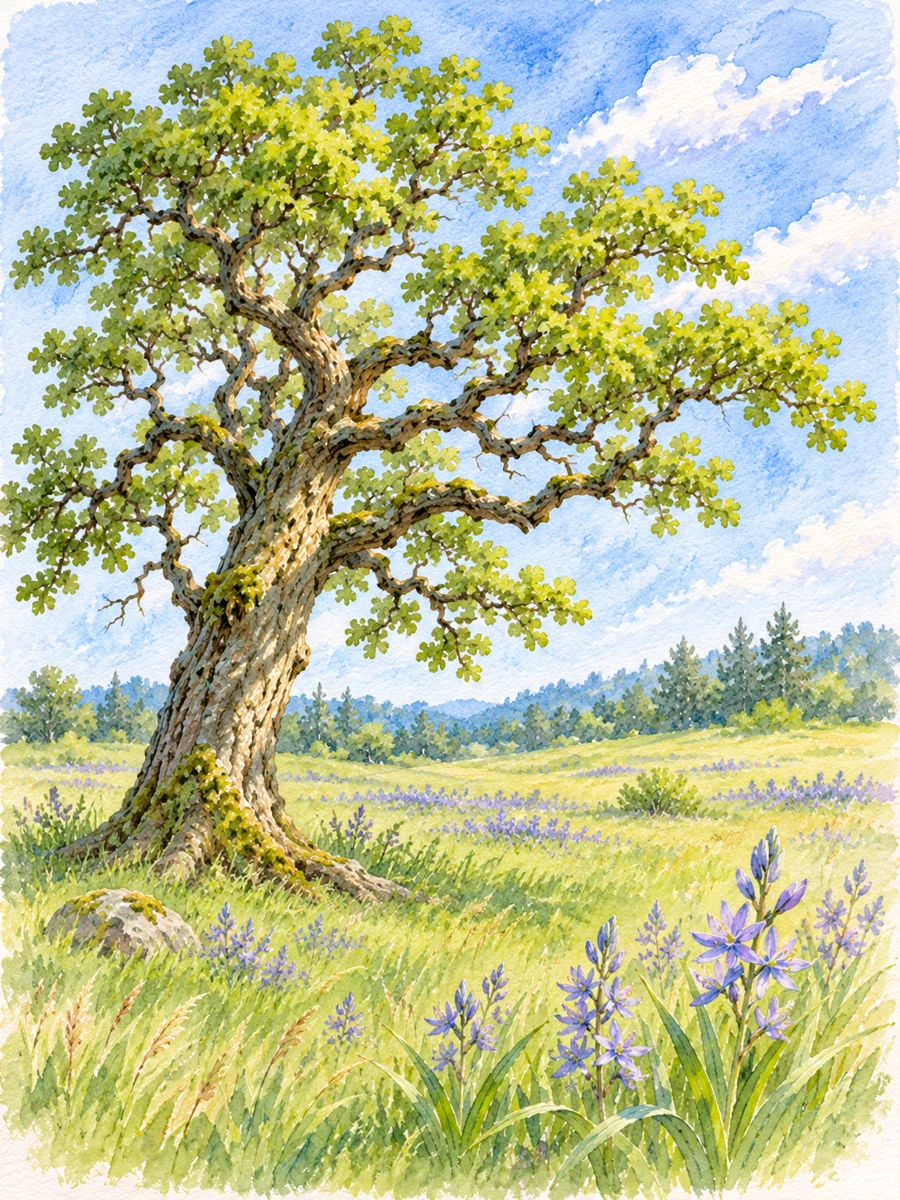
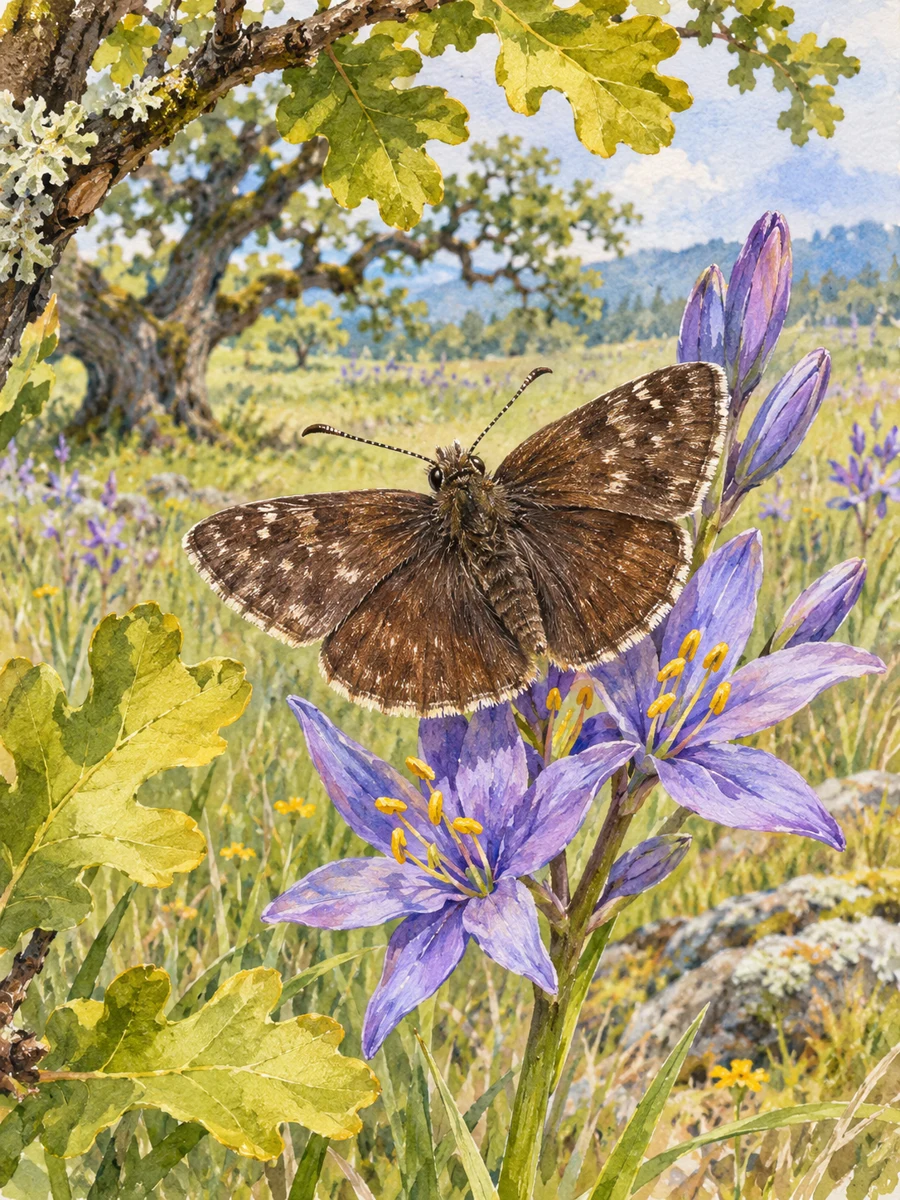
Each spring, Common Camas lifts slender stems of blue-violet flowers above a sweep of grass-like leaves. In southeastern Vancouver Island meadows, these delicate blooms are part of a much larger story: native pollinators, seasonally wet ground, and living Coast Salish relationships with a landscape cared for over generations. [1, 2, 5, 6, 8]
Listen to a brief overview
A short introduction to this species. Explore the full field notes below.
- Family
- Asparagaceae (asparagus family); formerly placed in Liliaceae.
- Plant type
- Native perennial herb growing from an underground bulb.
- Typical flowering stem
- About 20 to 70 cm tall; size varies with conditions.
- Flowers
- Pale to deep blue or violet, occasionally white; six separate petal-like segments (tepals) and six stamens.
A little learning to take home
Your free educational sheet
The illustration and a few carefully researched facts, together on one printable page.
Download educational PDFPrinting instructions
Use US Letter (8.5 × 11 inches), portrait orientation and Actual Size / 100% scale. Select Centre on Page if available. Choose high-quality colour printing and check the preview. The sheet includes ¾-inch margins; small alignment differences can occur between printers.
Free for personal and classroom use. The standalone artwork is not offered as a download.
Optional prints and gifts featuring this illustration.
AI-generated digital watercolour, carefully art-directed and reviewed. Our process.
A closer look
Field notes from the meadow
Blue stars across the spring meadow
How to recognize it
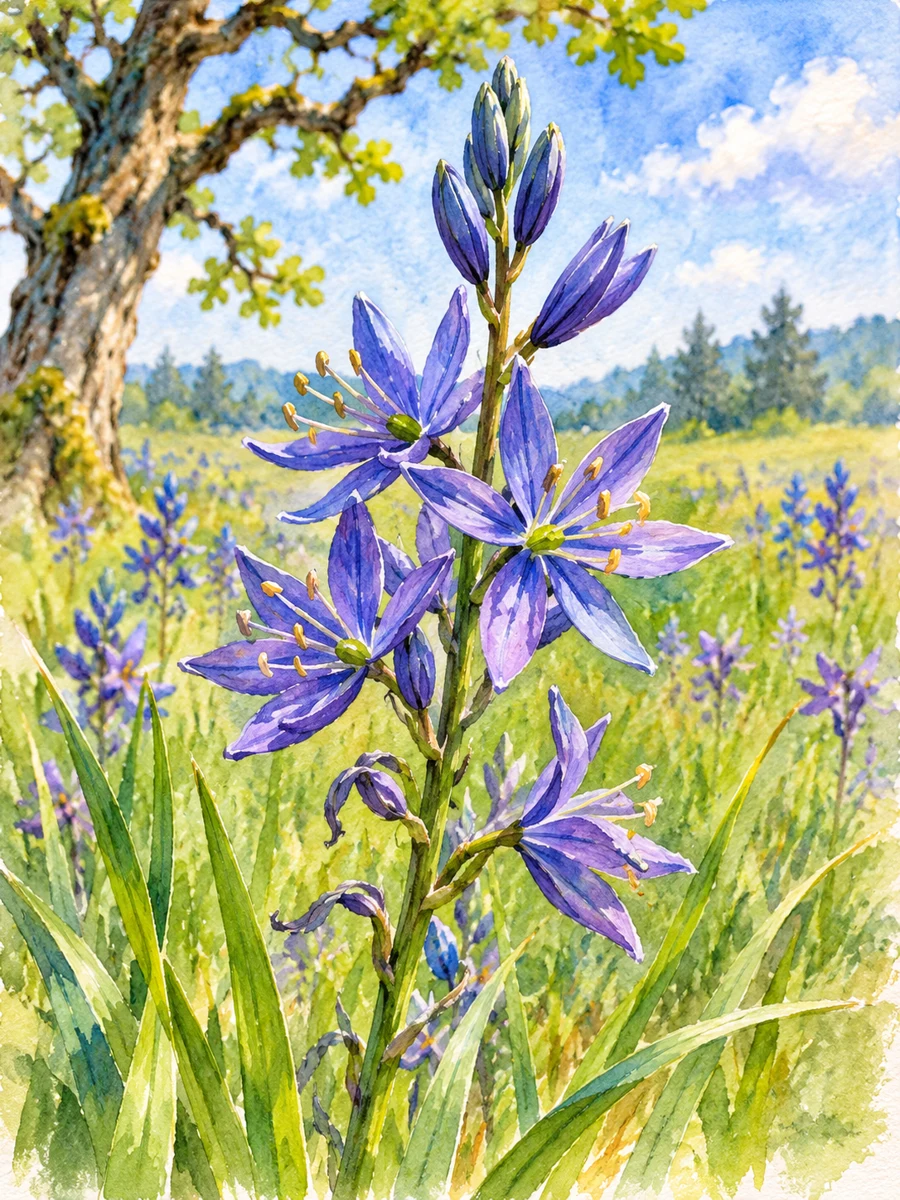
Look for a loose cluster of blue-violet, star-like blooms rising above a tuft of narrow basal leaves. Each flower has six petal-like tepals, six stamens and a central pistil. Individual blooms open along the stem at different times, so unopened buds and fresh flowers may be visible together. After flowering, the plant forms small capsules with dark seeds. [1, 2]
Common Camas and Great Camas can both occur in coastal meadows. One botanical distinction is how the spent flower segments behave: those of Common Camas generally remain separate, while those of Great Camas twist together around the developing ovary. This is a field clue, not a substitute for an expert identification. [1, 12]
Where it grows
Common Camas occurs in British Columbia and elsewhere in western North America. In BC it is associated with moderately moist to spring-wet meadows and grasslands, including southeastern Vancouver Island, the Gulf Islands and parts of the southern Interior. Some coastal habitats are wet in winter and spring yet become dry in summer. The species may grow among Garry Oak trees where sufficient light and suitable ground conditions remain. It does not occur beneath every Garry Oak. [1, 2]
A spring flowering cycle
Leaves emerge from the bulb as conditions warm and spring moisture is available. Flower stems develop in spring, with regional sources describing a typical flowering period from early April into May, and some local plants continuing to bloom in June. Pollinated flowers develop seed capsules, while the plant survives the dry portion of the year in its bulb. Flowering dates vary by year, soil moisture, elevation and site. [1, 2, 4]
Why Common Camas matters to pollinators
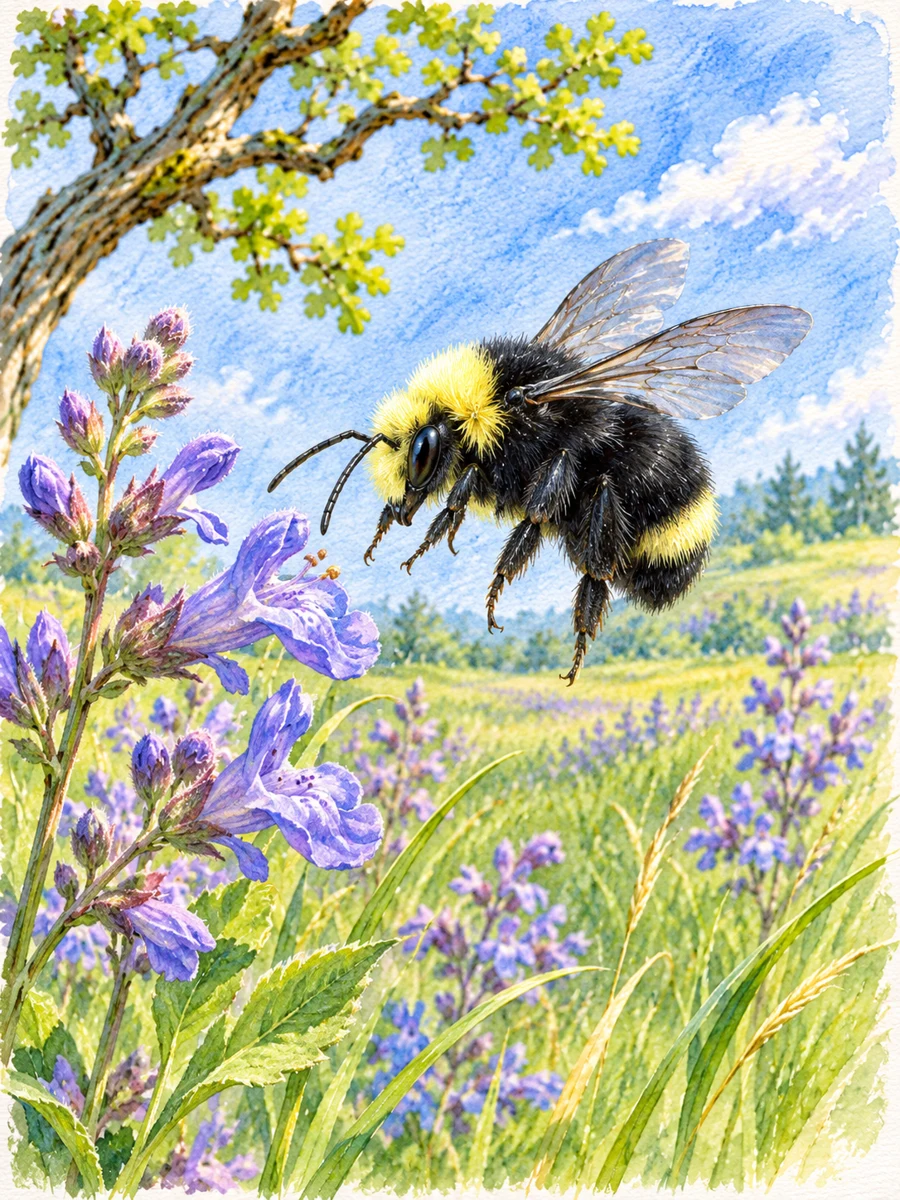
The flowers offer food to visiting insects and can be an important element of the spring floral landscape. A peer-reviewed study of Common Camas in oak-savannah habitat examined how different insect visitors moved pollen, including bumble bees, mason bees, other wild bees, honey bees and hover flies. It found that visitor behaviour differed, and that effective contact with the flower’s reproductive parts mattered for pollen transfer. A visitor is not automatically an equally effective pollinator. [4, 5]
Preserving native flowering plants helps maintain the mix of resources on which local insects rely. The particular bees present, and how much pollen they move, vary among places and study conditions. No single bee species is assumed to pollinate every camas population. [5, 11]
First Nations relationships and stewardship
Camas food systems are living cultural landscapes, not simply untended patches of wildflowers. Coast Salish Nations have long maintained relationships with camas through growing, tending, harvesting, cooking and sharing food. Practices and meanings differ across Nations, communities and places. At Fort Rodd Hill, Parks Canada identifies the ongoing stewardship of the lək̓ʷəŋən Peoples, known today as Esquimalt Nation and Songhees Nation, and describes camas meadows as landscapes shaped by Indigenous care. [6, 7]
The W̱SÁNEĆ Leadership Council describes the PENÁW̱EṈ (Camas Harvest Moon) and family journeys to gather ḰȽO¸EL (camas). This is a specifically W̱SÁNEĆ account; relationships and traditions differ among Nations. Salish Harvest also documents language names for camas, including Hul’q’umi’num Speenhw and lək̓ʷəŋən qʷɫəɫ. [8, 9]
For visitors, the appropriate lesson is respect for continuing Indigenous knowledge and stewardship, not a harvesting instruction. [7, 8, 10]
Conservation: the plant and the meadow are different questions
E-Flora BC lists both recognized BC subspecies, C. quamash subsp. maxima (coastal) and C. quamash subsp. quamash (interior), as provincially S4 and Yellow-listed, with status entries dated 2020. S4 is generally interpreted as apparently secure in the province. That does not mean every local camas meadow is secure. These are dated source records, not a new 2026 assessment. [1, 3]
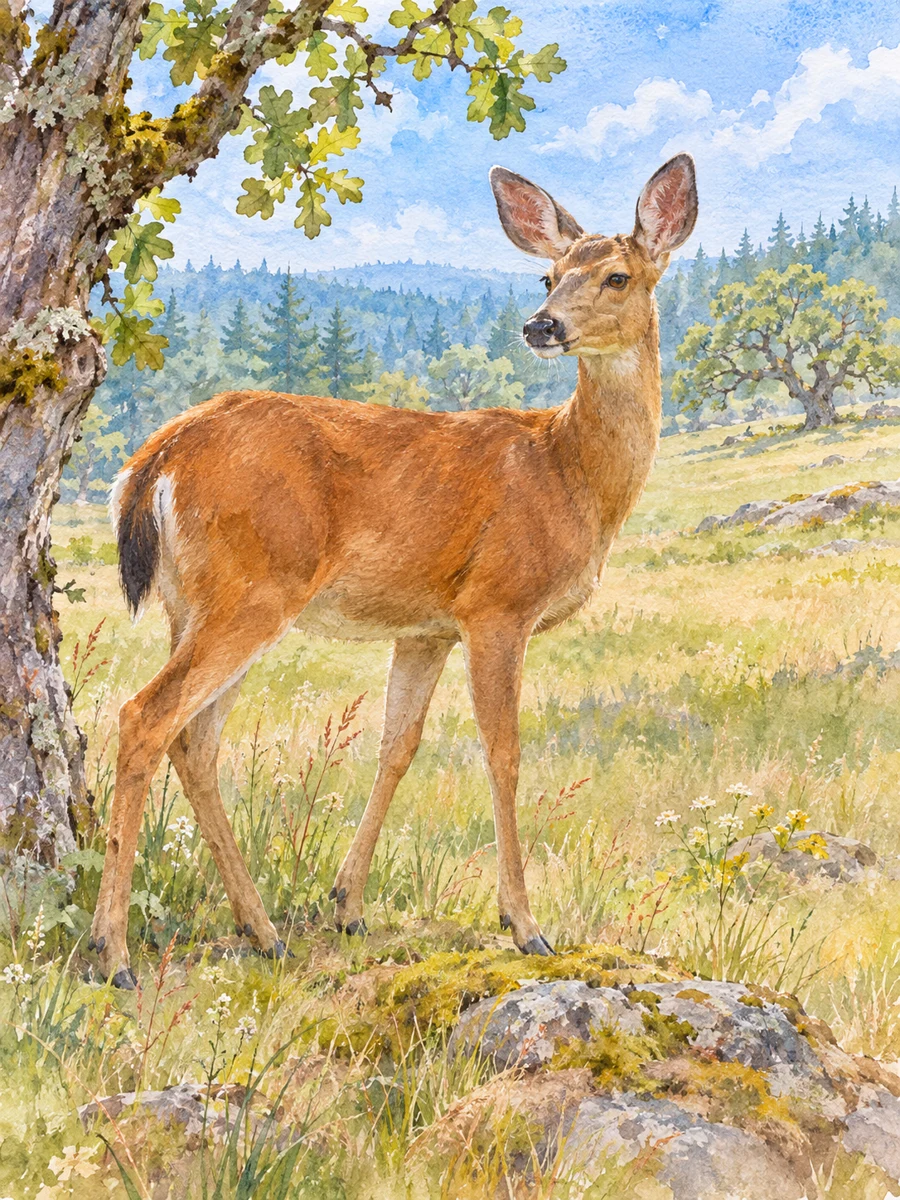
Garry Oak-associated meadows have been extensively reduced and fragmented by development and land-use change. Invasive plants, changes to fire and other historical land-care regimes, and unusually high browsing pressure can further alter remaining habitats. A 2022 study across ten Salish Sea islands found that higher black-tailed deer presence was associated with fewer flowering plants, especially native species used by bumble bees, and with indirect effects on bumble bee abundance. These results concern sampled islands, not a uniform effect across all BC camas sites. [6, 7, 11]
Protecting camas therefore also means protecting the seasonal moisture, sunlight, native plant community and stewardship relationships of the meadow in which it grows. [1, 6, 7]
Five details worth noticing
1. A Common Camas flower has six tepals, not six separate “petals” in the strict botanical sense. [1]
2. Its narrow leaves start at the base, while the upright stem carries a series of buds and flowers. [1, 2]
3. A single population can show several shades of blue or violet, and occasional white flowers are documented. [1]
4. The coastal and dry-interior BC subspecies are distinguished botanically; the illustration does not establish a subspecies identification. [1, 3]
5. Camas landscapes are simultaneously habitat, food systems and places of continuing Indigenous stewardship. [6, 7, 8]
A respectful and safe way to enjoy it
Admire the spring flowers without picking them or digging bulbs. Common Camas may be confused with poisonous death camas, particularly when flowers are absent; identification mistakes can have serious consequences. This educational project does not provide wild-food identification or preparation advice and does not recommend eating any wild bulbs. Stay on established paths where available and follow local conservation and Indigenous guidance. [9, 10]
Sources & further reading
Numbered citations in the text refer to the directly checked sources below. Source descriptions indicate the claims each source supports. Verification performed 8 November 2026; conservation rankings retain the older source dates explicitly.
1. E-Flora BC, Camassia quamash
Taxonomy, family, dimensions, flowers, fruit, provincial distribution, subspecies distinction and 2020 status table.
https://linnet.geog.ubc.ca/Atlas/Atlas.aspx?sciname=Camassia+quamash
2. Garry Oak Ecosystems Recovery Team, Common Camas
Botanical description, Garry Oak association and spring flowering.
https://goert.ca/species/camassia-quamash/
3. E-Flora BC, Camassia quamash subsp. maxima
Coastal subspecies characters and BC S4 / Yellow status shown for both subspecies (2020).
https://linnet.geog.ubc.ca/Atlas/Atlas.aspx?sciname=Camassia+quamash+ssp.+maxima
4. Victoria Airport Authority, Common Camas
Victoria-area flowering window, ecological context, nectar and W̱SÁNEĆ-related public interpretation.
https://yyj.ca/en/environment-sustainability/common-camas/
5. Rammell, Gillespie and Elle (2019), The Canadian Entomologist 151, 58–68
Peer-reviewed insect visitor behaviour and pollen transport; published online 6 December 2018.
6. Parks Canada, Garry Oak Ecosystems in BC
Fort Rodd Hill, lək̓ʷəŋən stewardship, major landscape threats and conservation context.
https://parks.canada.ca/lhn-nhs/bc/fortroddhill/nature/garry
7. Parks Canada, Ecosystem restoration at Fort Rodd Hill
Indigenous-led stewardship, cultural burning and contemporary meadow restoration.
https://parks.canada.ca/lhn-nhs/bc/fortroddhill/nature/garry/ecosysteme-ecosystem
8. W̱SÁNEĆ Leadership Council, W̱SÁNEĆ’s Traditions During the PENÁW̱EṈ
Nation-published W̱SÁNEĆ camas harvesting and language context.
9. Salish Harvest, Common Camas
Language names and cultural food systems; use source-specific spelling.
https://www.salishharvest.org/library/common-camas
10. Kootenay Native Plant Society, Camas
Strong poison/death-camas caution; safety principle applies beyond its interior-BC study area.
https://kootenaynativeplants.ca/our-work/camas/
11. Beckett et al. (2022), Global Ecology and Conservation 38, e02237
Field study of black-tailed deer, flowering plants and bumble bees on ten Salish Sea islands.
https://www.sciencedirect.com/science/article/pii/S2351989422002396
12. E-Flora BC, Camassia leichtlinii
Botanical differentiation of Great Camas and Common Camas.
https://linnet.geog.ubc.ca/Atlas/Atlas.aspx?sciname=Camassia+leichtlinii