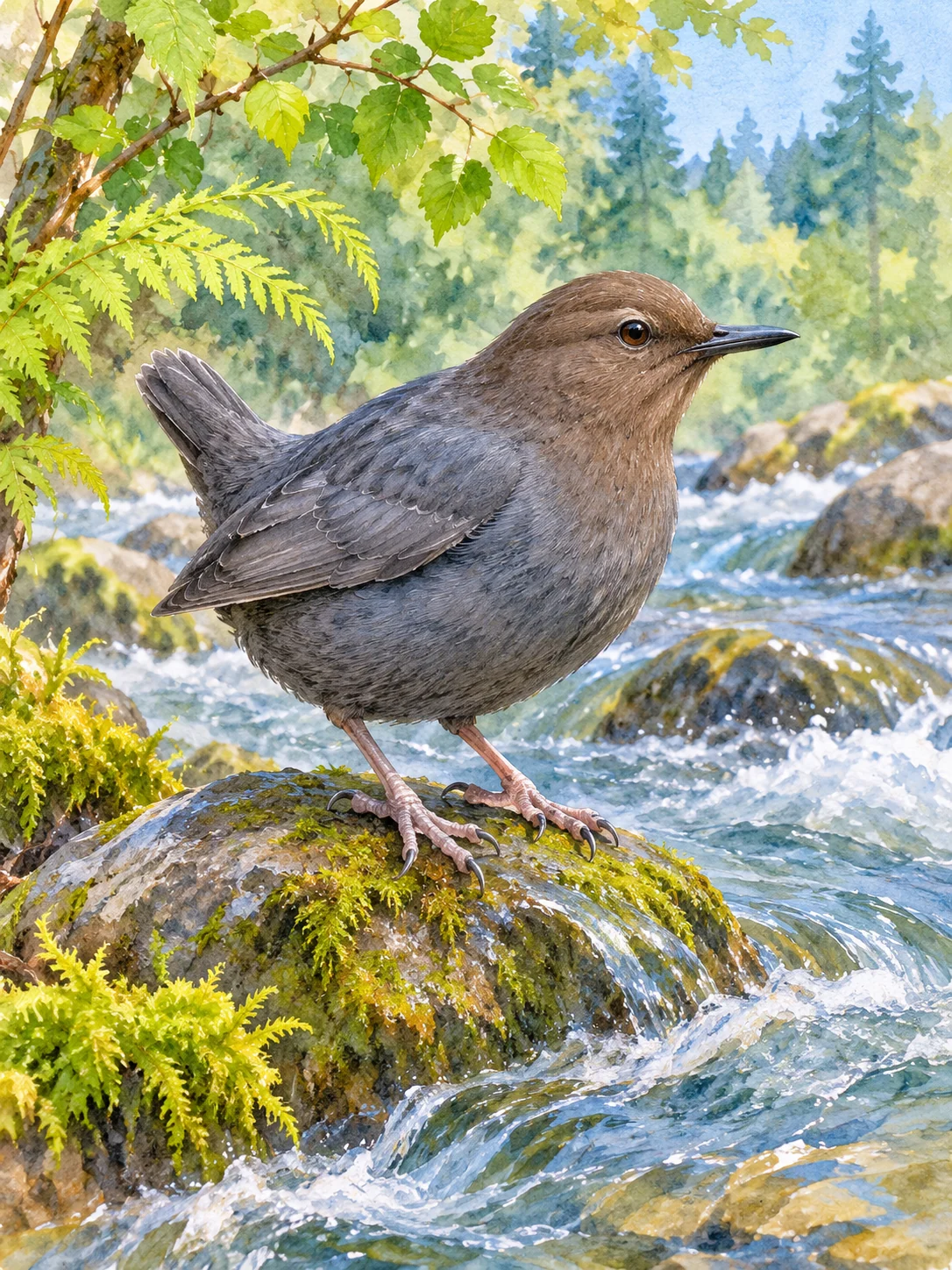
Species at a glance
- Common name
- American Dipper (also called Water Ouzel)
- Size
- About 19 cm long on average; roughly 18 to 22 cm overall
- Appearance
- Plump, slate-grey body, subtly warmer brown head, short upturned tail, slender dark bill, pale feet and white eyelids that flash when blinking
- British Columbia range
- Widespread in southern BC, including Vancouver Island, and more sparsely distributed elsewhere
- Food
- Primarily aquatic insect larvae; also other small aquatic animals, including occasional fish eggs and small fish
- Season
- Present year-round, with some birds moving between winter and breeding stream reaches
How to recognize it
Look for a compact, round-bodied bird with uniform slate-grey plumage and a gently brown-tinged head. Its dark bill is slender and straight. The tail is unusually short and often tilted upward. Males and females look much alike. Unlike most birds that frequent water, the dipper has long, strong toes rather than webbed feet. [3, 4]
Its behaviour is often the clearest clue. The bird repeatedly bends its legs and bobs its whole body beside a rapid. When it blinks, tiny white feathers on the eyelids appear in a quick flash. Listen for clear, lively notes carrying over the sound of moving water. Young birds can show paler, scalloped feathers and a yellowish bill base, so their colouring should not be confused with that of an adult. [3, 4]
Built for cold, moving water
The American Dipper does something few songbirds can: it dives beneath the surface, propels itself with its wings and grips streambed stones as it searches for food. Its dense insulating feathers and large preen gland help it remain active in cold water. A transparent protective eyelid can sweep across its eye, and flaps close over its nostrils while submerged. Typical dives last only a few seconds, but they are long enough to search beneath stones. [3, 4]
These abilities make the dipper a skilled forager, not a duck in disguise. Its feet are those of a perching songbird, adapted to gripping wet rock rather than paddling with webs. [3, 4]
Where it lives in British Columbia
American Dippers follow the moving water. In British Columbia they occur along cold coastal streams and mountain rivers, particularly where shallow, rocky margins, riffles and cascades make aquatic prey accessible. Forested streambanks, boulders, logs and overhanging ledges offer shelter and perches. The BC Breeding Bird Atlas describes the species as relatively widespread in southern BC, but generally uncommon and localized because its preferred habitat is so specific. [1, 2]
The species is found on Vancouver Island as well as the mainland. It may use the rocky edges of lakes, and some individuals visit larger, ice-free rivers in winter. It does not require a salmon run to live in a stream, but salmon-bearing waters provide an important seasonal connection. [1, 2, 5]
Life through the seasons
Although dippers may be seen in BC in any month, not every bird spends the entire year in one place. Research in the Chilliwack River watershed documented a mix of year-round main-river residents and birds that wintered on the lower river before moving into higher tributaries to breed. In that watershed during 1999 to 2002, researchers estimated that most observed birds belonged to the seasonally moving group. Those figures describe a particular studied population, not every dipper in British Columbia. [5, 6]
In spring, pairs establish territories along suitable streams. They may sing from rocks beside rapids or from exposed branches above the water. As streams swell or freeze, local movements can help birds reach stretches where prey remains accessible. [2, 4, 6]
Food and the salmon-stream connection
Most of a dipper’s meals are the young aquatic stages of insects such as caddisflies, stoneflies and mayflies. It picks these animals from the undersides of stream stones or from pockets of current where they collect. Dippers can also eat other small stream animals, including snails, fish eggs and small fish. [1, 3, 4]
The link with Pacific salmon is more than a shared backdrop. Researchers studying the Chilliwack River in southwestern BC directly observed dippers feeding on salmon eggs in shallow winter pools. These meals can connect spawning salmon with a bird that otherwise depends heavily on aquatic insects. The relationship is documented in this watershed and should not be assumed to occur equally in every salmon stream. [5]
A nest above the current
American Dippers build bulky, rounded nests from moss, grasses and other plant material. A small opening in the side leads to a sheltered cup within. Nests are often tucked onto a rock ledge, behind a waterfall, beneath an overhang or under a bridge, usually close to rushing water. [1, 4]
A typical northern clutch contains about four or five white eggs. The female incubates them, and both parents help feed the young. Successful pairs may raise a second brood when conditions and timing allow. Nest sites can be difficult to spot, so a bird carrying food near a bridge or waterfall is a reason to give the area extra space. [1, 4]
Stream health and stewardship
Dippers depend on functioning freshwater habitats: streams with reliable flows, suitable rocky beds, insect prey and places to nest safely. A BC study of the Chilliwack watershed used dipper feathers and diet to investigate exposure to trace metals, demonstrating how these birds can contribute to watershed monitoring. A dipper’s presence alone, however, does not prove that a stream is pollution-free. [2, 7]
The BC Conservation Data Centre places the species on the provincial Yellow List with an S4 rank, meaning Apparently Secure in BC. That is different from its national population trend: the 2024 State of Canada’s Birds account reports an estimated 28% Canadian decrease since the early 1970s, while noting that standard bird surveys do a poor job of sampling this stream-dependent species. American Dippers are protected under the federal Migratory Birds Convention Act, 1994; no SARA schedule listing is shown in the BC Conservation Data Centre record. [1, 8, 9]
Caring for streamside vegetation, avoiding contamination and sediment runoff, maintaining natural streamflow and protecting active nests can benefit dippers as well as many other residents of British Columbia’s waterways. [2, 4, 7]
Five details worth noticing
- A blink can reveal a bright white eyelid against otherwise dark plumage. [3, 4]
- Dippers can walk along streambed stones without having webbed feet. [3, 4]
- Their short tails are often cocked upward, especially when the bird pauses on a rock. [3]
- Some Chilliwack River birds move upstream to breed, while others stay on the main river year-round. [5, 6]
- Research in southwestern BC has recorded American Dippers eating salmon eggs during winter. [5]
A respectful way to enjoy it
Watch quietly from a safe public trail or riverbank. Look for a single, dark bird making repeated little bows on a midstream rock, then follow its movements as it disappears into the current. Keep well back from slippery banks and fast water, and avoid lingering beneath suspected nest sites or disturbing birds carrying food. Binoculars and patience are better than approaching closely. [3, 4]